Frost/Nixon
Feb. 8th, 2009 10:38 am![[personal profile]](https://www.dreamwidth.org/img/silk/identity/user.png) major_clanger
major_clanger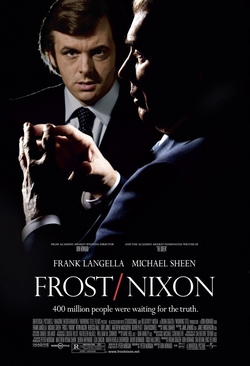
As I commented to
![[livejournal.com profile]](https://www.dreamwidth.org/img/external/lj-userinfo.gif) rozk coming out of the cinema, it's not often that you see a major motion picture where one of the lead characters is John Birt.
rozk coming out of the cinema, it's not often that you see a major motion picture where one of the lead characters is John Birt. But there he his, played by Matthew Macfadyen as producer to Michael Sheen's thirtysomething David Frost. Sheen's portrayal of Frost is, by reference to tapes from the actual interviews, physically very close, albeit overlaid with the unmistakable stamp of his Tony Blair from The Queen - the same permanent smile pasted over every other facial emotion. Frank Langella, by contrast, looks far less like Nixon than he does his Soviet counterpart Brezhnev. Yet by the final segment of the film, he has Nixon's mannerisms and personality off so well it's hard to believe it's not Tricky Dicky himself.
Early in the film, there is talk of the Frost giving Nixon "the trial he never had" and of Nixon being 'cross-examined'. In fact, as someone learning to be an advocate, much of what we see is a good case-study in how not to question a hostile witness. Frost seems too ready to fall into the role of chat-show host rather than interviewer - a point scathingly made to him at one point - and asks open, non-leading questions to a subject only too ready to take control and ramble off into the conversational distance. Only at the end, goaded by Nixon in a bizarre late-night call, does Frost turn into something resembling a prosecution advocate, firmly putting clear, direct accusations to Nixon and insisting on an answer. Even then, he has the advantage of damning evidence to ambush Nixon with; a little thing called 'disclosure' means real lawyers rarely have such an easy shot.
Is the film a faithful recreation of the real interviews? No, and not just because by all accounts there was no drunken call from Nixon to Frost. The film gives the impression they were shot in four sessions, with all the hard questions being asked at the end; in fact, Nixon and Frost spoke for 28 hours over 12 days before being edited down to four 90-minute programmes. Ron Howard gives us a retconned version, where the interviews take place almost in their final broadcast form, and with Frost floundering to pin his target down to an admission of guilt. But that is to a large extent what the film is about, a metaphor for the wider search for Presidential accountability. In the end, all we care about is the narrative drive towards Frost eliciting from Nixon some, any, admission that what he did was wrong.
Like so much drama or writing set in other times, Frost/Nixon is really about our present. As
purplecthulhu commented afterwards, it stands in for now as a substitute for the interviews with another ex-President so many would like to see, and the admissions so many would like to hear.


![[identity profile]](https://www.dreamwidth.org/img/silk/identity/openid.png)
no subject
Date: 2009-02-08 11:24 am (UTC)I'm glad I'm not the only one who thought Langella looked like Brezhnev at times. Sheen, though, I thought was excellent. Sometimes he really seemed to become Frost — the "weren't they terrific?" line about the Bee Gees was spot on.
As you say, the film hugely simplifies the course of events; it also presents Frost as someone whose career is on the wane, which isn't really the case. Nixon wasn't, I believe, the first politician Frost interviewed. I recall, too, that Clive James said if you watched all the interviews in the correct order, it made the nailing of Nixon at the end much more impressive (in the UK, the Watergate one was broadcast first); seeing the Watergate one alone, Frost seems to give him a relatively easy ride.
It is interesting to see a film set at a time when people were shocked that the President might do Bad Things.